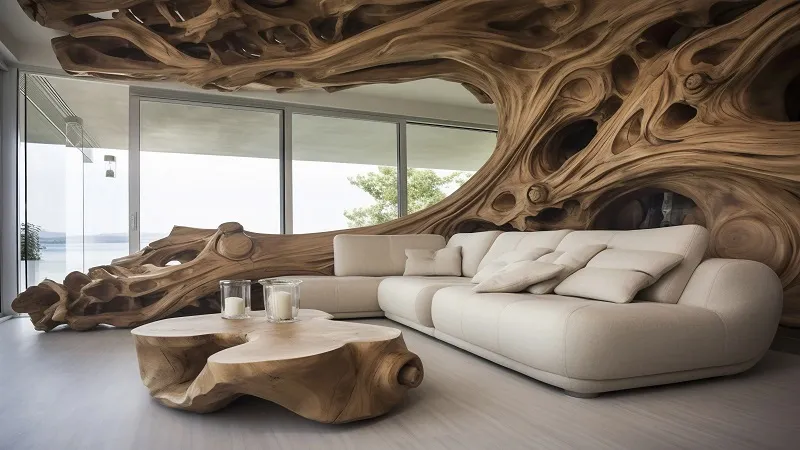
When we think about bringing art into our homes, our minds immediately go to the walls. We spend months hunting for the perfect canvas, curating gallery walls of framed photography, or installing floating shelves to display ceramics. We treat art as something to be observed from a distance, completely separate from the functional objects we use every day.
But as interior design trends in 2026 shift aggressively toward authenticity, sustainability, and “biophilic” (nature-loving) spaces, a new philosophy is emerging. Top architects and designers are challenging the idea that art must hang on a wall. Instead, they are placing the room’s most expressive, artistic masterpiece right in the middle of the floor.
By treating the living room table not just as a place to set a coffee mug, but as a heavily textured, sculptural focal point, you can fundamentally change the aesthetic gravity of your home.
The Problem with the “Sterile Box”
For the last decade, the default aesthetic for living room centerpieces was stark, cold minimalism. We saw millions of perfectly square, high-gloss white boxes or razor-thin glass rectangles supported by geometric metal frames.
While these mass-produced designs look clean, they often leave a room feeling sterile and emotionally flat. They are purely utilitarian. Manufactured using medium-density fiberboard (MDF) and printed veneers, these pieces lack the unique “thumbprint” of nature. When every piece of furniture in a room is perfectly uniform and machine-made, the human eye quickly becomes bored. The space lacks soul.
The Rise of Burl and Raw Grain
The antidote to this sterile uniformity is the “Natural Material Renaissance.” In 2026, the absolute pinnacle of luxury is imperfection.
Instead of hiding wood grain under thick layers of dark, opaque stain, designers are celebrating the raw, chaotic beauty of the timber itself. This has led to a massive resurgence in the use of highly expressive woods, most notably walnut burl and reclaimed, live-edge timber.
Burl wood is created when a tree undergoes stress—like a fungal infection or a rapid change in climate—causing the grain to grow in wild, twisting, mesmerizing knots rather than straight lines. When sliced and polished, it looks like a topographical map or a swirling galaxy.
Because this material is created entirely by the chaotic forces of nature, a table crafted from burl or a live-edge slab is completely non-repeatable. It is physically impossible for anyone else in the world to own the exact same piece. It ceases to be just a piece of furniture; it becomes a functional, one-of-a-kind sculpture.
Tactility and the Sensory Home
The appeal of a raw-wood centerpiece extends far beyond its visual beauty. It taps into a deep, psychological need for sensory engagement.
As we spend more of our daily lives interacting with the smooth, cold, frictionless glass of our smartphones and tablets, we crave tactile feedback in our physical environments. We want to run our hands over the grooves of a natural wood grain. We want to feel the warmth and density of solid timber.
By anchoring your living room with a highly tactile piece of wood, you ground the space. It subconsciously signals to the brain that this is a space of comfort, permanence, and connection to the natural world.
The Economics of Sustainable Luxury
Treating your centerpiece as a work of art also fundamentally shifts how you view furniture consumption.
The era of “fast furniture”—buying a cheap, trendy table that chips in a year and ends up in a landfill—is rapidly falling out of favor due to its devastating environmental impact. When homeowners invest in quality coffee tables crafted from sustainably harvested, renewable, or upcycled wood, they are participating in a circular economy.
A solid wood table finished with low-VOC, water-based sealants does not off-gas toxic chemicals into your living room. More importantly, it is designed for longevity. When a solid wood table gets scratched, it isn’t ruined; it simply gains patina, and if necessary, it can be sanded down and refinished for the next generation. It is an heirloom, not a disposable commodity.
How to Style a Sculptural Anchor
If you choose to make a heavily grained, sculptural table the artistic focal point of your living room, you must adjust how you style the rest of the space to avoid visual chaos:
- Let It Breathe: Do not suffocate the table with oversized trays, massive floral arrangements, or stacks of magazines. If the wood grain is the art, let it be seen. A single, simple ceramic bowl or a minimalist vase is all you need.
- Contrast the Geometry: If your table features a wild, organic, flowing shape, pair it with a sofa that has clean, structured, architectural lines. This creates the “design tension” that makes high-end rooms feel curated.
- Simplify the Walls: If the center of the room is visually loud and expressive, quiet down the walls. You no longer need a massive, chaotic gallery wall to give the room personality.
Your living room is the gravitational center of your home. By investing in a piece of furniture that is as beautifully chaotic as nature itself, you ensure that the center of your room is always a conversation starter.